Search This Blog

Showing posts with label UNIVERSE. Show all posts

Sunday, December 5, 2010

Strange Planets !

Strange Planets !

Other Earth like planets in the neighboring solar systems ,
which are supposed to have life,
Among the more than 400 planets found beyond our solar system, there are volcanic Super Earths, gas giants that dwarf Jupiter, and worlds with multiple sunsets.
Here are 20 of the most incredible, starting with the very first alien world - 51 Pegasi b was the first planet
discovered in orbit around a normal star other than our Sun. It was found in 1995.


The largest exoplanet ever discovered is also one of the strangest and theoretically should not even exist, scientists say. Dubbed TrES-4, the planet is
about 1.7 times the size of Jupiter and belongs to a small subclass of so-called puffy planets that have extremely low densities. The planet is located
about 1,400 light years away from Earth and zips around its parent star in only three and a half days.

Epsilon Eridani b orbits an orange Sun-like star only 10.5 light years away from Earth. It is so close to us telescopes might soon be able to photograph it.
It orbits too far away from its star to support liquid water or life as we know it, but scientists predict there are other stars in the system that might be good candidates for alien life.


This planet, CoRoT-7b, was the first confirmed rocky world outside our solar system, but it doesn't look like a particularly pleasant place to live. It is tidally
locked to its parent star, and sees hellish 4,000 degrees Fahrenheit (2,200 degrees Celsius). It may also rain rocks and be the core of a vaporized gas giant. 


Luke Skywalker's home planet of Tatooine in Star Wars had two suns, but that's paltry compared to a Jupiter-like planet 149 light-years from Earth.
This planet has three suns, with the main star similar in mass to our own sun. The triple-star system is known as HD 188753.
Like Tatooine, the planet there is likely pretty hot. It orbits very close to the main star, completing one orbit every 3.5 days.


The youngest exoplanet yet discovered is less than 1 million years old and orbits Coku Tau 4, a star 420 light-years away. Astronomers inferred
the planet's presence from an enormous hole in the dusty disk that girdles the star. The hole is 10 times the size of Earth's orbit around the
Sun and probably caused by the planet clearing a space in the dust as it orbits the star.


The oldest known planet is a primeval world 12.7 billion years old that formed more than 8 billion years before Earth and only 2 billion years after the Big Bang.
The discovery suggested planets are very common in the universe and raised the prospect that life began far sooner than most scientists ever imagined


Astronomers are finding many worlds now in a category of worlds called Super-Earths, which are between 2 and 10 times the mass of our own Earth.
A world called HD156668b is the second smallest after Gliese 581 e. Some scientists think such worlds could be more susceptible to forming the
conditions for life because their cores are hot and are conducive to volcanism and plate tectonics.

A planet called WASP-12b is the hottest planet ever discovered (about 4,000 degrees Fahrenheit,
or 2,200 degrees Celsius), and orbits its star closer than any other known world. It orbits its star once every
Earth day at a distance of about 2 million miles (3.4 million km). WASP-12b is a gaseous planet, about 1.5 times the mass of Jupiter,
and almost twice the size. It is 870 light-years from Earth.
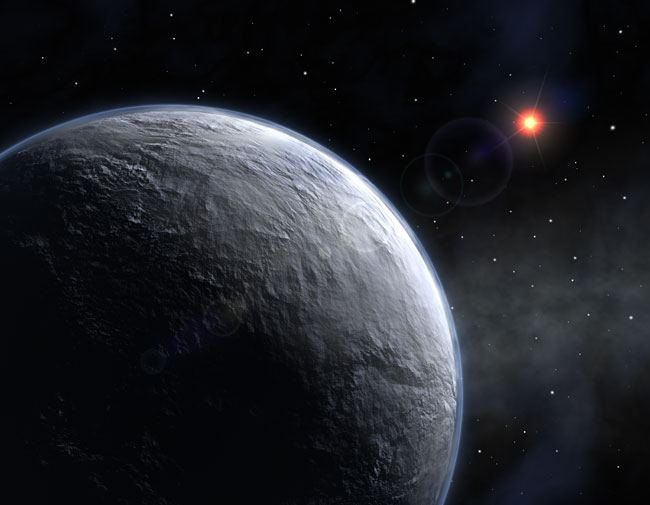
 
With a surface temperature of -364 degrees Fahrenheit (-220 degrees Celsius), the extrasolar planet known as OGLE-2005-BLG-390L b is likely
the coldest alien world. It is about 5.5 times as massive as Earth and thought to be rocky.
It orbits a red dwarf star about 28,000 light-years away, making it the most distant exoplanet currently known.

When astronomers observed WASP-18b, they may have seen it in the cosmic moment before its death.
This planet whips around its star in less than one Earth day. Scientists think that this speed coupled with the planet's heft yields strong
gravitational tugs that can alter the planets orbit. If the planet orbits faster than its star spins, it should gradually be moving inward towards its sun, and its doom. Credit: C. CARREAU/ESA/Nature
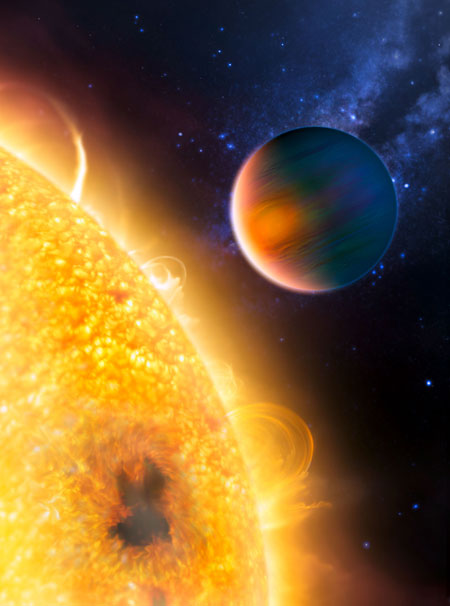
Astronomers have been able to detect the atmospheres around several exoplanets, including HD 189733b, one of the first alien words to have
its atmosphere sniffed to determine its composition. Glowing methane, which can be produced naturally or possibly signal a biological byproduct,
has been detected on the planet. Credit: ESA, NASA and G. Tinetti
 
The extrasolar planet GJ 1214b is a rocky planet rich in water that sits about 40 light-years away. It orbits a red dwarf star.
It is the only known Super-Earth exoplanet — worlds that have masses between Earth and Neptune — with a confirmed atmosphere. The planet is about
three times the size of Earth and about 6.5 times as massive. Researchers think it is likely a water world with a solid center. Credit: David A. Aguilar, CfA 

SWEEPS-10 orbits its parent star from a distance of only 740,000 miles, so close that one year on the planet happens every 10 hours.
The exoplanet belongs to a new class of zippy exoplanets called ultra-short period planets, which have orbits of less than a day.
 
Most planets orbit in a plane that corresponds to their parent star's equator. But XO-3b orbits with a crazy tilt of 37 degrees from its star's equator.
The only other known example of such an oddly angled orbit was Pluto, until its demotion to dwarf planet status. There is, however, a planet known to
orbit backwards around its parent star. Credit: NASA. ESA, amd G. Bacon (STScI)

While Neptune has a diameter 3.8 times that of Earth and a mass 17 times Earth's, this Super-Neptune world (named HAT-P-11b) is
4.7 times the size of Earth and has 25 Earth masses. The newfound world orbits very close to its star, revolving once every 4.88 days. As a result,
it is baked to a temperature of around 1100 degrees F. The star itself is about three-fourths the size of our Sun and somewhat cooler.

A planet lighter than a ball of cork is one of the puffiest alien planets known to date. Called HAT-P-1, the planet is about half as
massive as Jupiter but about 1.76 times wider-or 24 percent larger than predicted by theory. It could float in water, if there was a tub large enough to hold it. 
 
One of the several planets within the Gliese 581 star system, called Gliese 581 d, may be one of the most habitable alien worlds known.
Its orbit is at just the right distance for water to potentially exist on the surface. Water is a key ingredient for life as we know it. Gliese 581 is a red dwarf star
20.5 light-years from Earth. It is about 8 times the mass of Earth, and located in an orbit just right for liquid water

One of the densest exoplanets to date is a world known as COROT-exo-3b. It is about the size of Jupiter, but 20 times that planet's mass, making it about
twice as dense as lead. Scientists have not ruled out that the COROT-exo-3b may be a brown dwarf, or failed star.

Wednesday, December 2, 2009

The Hubble Photos...Amazing

After correcting an initial problem with the lens, when the Hubble Space Telescope was first launched in 1990, the floating astro-observatory began to relay back to Earth, incredible snapshots of the 'final frontier' it was perusing.

Recently, astronauts voted on the top photographs taken by Hubble, in its 16-year journey so far.Remarking in the article from the Daily Mail, reporter Michael Hanlon says the photos 'illustrate that our universe is not only deeply strange, but also almost impossibly beautiful.'

Hubble telescope's top ten greatest space photographs


The Sombrero Galaxy - 28 million light years from Earth - was voted best picture taken by the Hubble telescope. The dimensions of the galaxy, officially called M104, are as spectacular as its appearance. It has 800 billion suns and is 50,000 light years across.


The Ant Nebula, a cloud of dust and gas whose technical name is Mz3, resembles an ant when observed using ground-based telescopes. The nebula lies within our galaxy between 3,000 and 6,000light years from Earth.


In third place is Nebula NGC 2392, called Eskimo because it looks like a face surrounded by a furry hood. The hood is, in fact, a ring of comet-shaped objects flying away from a dying star. Eskimo is 5,000light years from Earth.


At four is the Cat's Eye Nebula


The Hourglass Nebula, 8,000 light years away, has a pinched-in-the- middle
look because the winds that shape it are weaker at the centre.

In sixth place is the Cone Nebula. The part pictured here is 2.5 light years in
length (the equivalent of 23 million return trips to the Moon).


The Perfect Storm, a small region in the Swan Nebula, 5,500 light years away,
described as 'a bubbly ocean of hydrogen and small amounts of oxygen, sulphur and other elements'.


Starry Night, so named because it reminded astronomers of the Van Gogh painting. It is a halo of light around a star in the Milky Way.


The glowering eyes from 114 million light years away are the swirling cores of two merging galaxies called NGC 2207 and IC 2163 in the distant Canis Major constellation.


The Trifid Nebula. A 'stellar nursery', 9,000 light years from here, it is where new stars are being born.

Saturday, May 23, 2009

universe

Solar Activity Heats Up

August 28 saw a major solar flare erupting from a complex sunspot group crossing the Sun's southern hemisphere. The intensity of the eruption placed it in the most powerful "X" category. The flare was accompanied by a coronal mass ejection (CME) which was clocked at 600 km/hr as it headed past the Earth. This CME passed south of Earth's orbital plane and did not cause any major effects here. However, CMEs that collide directly with the Earth can excite geomagnetic storms, which have been linked to satellite communication failures. In extreme cases, such storms can induce electric currents in the earth and oceans that can damage electric power transmission equipment. Scientists expect to see solar flare-ups daily during the solar max, which is expected in mid-2000.

Leaking Earth Could run dry

Researchers from the Tokyo Institute of Technology say that Earth could be dry and barren within a billion years because the oceans are draining into the planet's interior. They have calculated that about 1.12 billion tonnes of water leaks into the Earth each year. Although a lot of water also moves in the other direction, not enough comes to the surface to balance what is lost. The scientists believe that eventually all of it will disappear. They predict that the Earth's surface will look a lot like the surface of the planet Mars where a similar process seems to have taken place. This research was published in the New Scientist magazine. Mir drifts free

Russian space station Mir has gone into "free drift" mode as control passes to a new onboard computer. The free flight is necessary to reduce power consumption so that Mir can survive for months in space before a possible return by cosmonauts. The last crew left on August 27, just 10 days before Mir would have celebrated 10 years of continuous crewing. The new computer keeps the solar panels pointed at the Sun so Mir's batteries remain charged. Russia is expected to make a decision late this year or early next on whether Mir will remain in orbit. The station costs about $250 million a year to operate and while this is not too high in space terms, Russia just doesn't have the money.

Shaking Earth

The centuries-old mystery of why the Earth appears to wobble has been solved. Every 1.2 years, the planet appears to move about its axis by about 20 ft at the North Pole, but since discovering the so-called Chandler Wobble in 1891, scientists had been unable to explain it. Now NASA believes that the cause lies in the Earth's oceans. Fluctuating pressure of water on the ocean bed caused by temperature, salinity and current changes - forces the Earth to move slightly on its axis. Atmospheric fluctuations add to the wobble. The findings were made by analyzing data from the International Earth Rotation Service, set up in Paris in 1988.

Moon Magic

The Moon has always been an object of fantasy as well as research but we still don't know exactly how the Earth got its moon.

According to the 'giant impact theory', proposed in the 1970s, the moon was formed after the Earth was hit by a huge object, as big as Mars.

Using the new model, researchers at the Southwest Research Institute and the University of California at Santa Cruz, created high-resolution simulations to show that an oblique impact by an object with 10 per cent of the mass of Earth could have ejected sufficient iron free material into Earth's orbit to eventually coalesce into the moon, while also leaving the Earth with its present mass and correct initial rotation rate.

The simulation also implies that the moon formed near the very end of Earth's formation, some 4.5 billion years ago. The moon is believed to have played an important role in making the Earth habitable because of the stabilizing effect it had on the tilt of Earth's rotation.

New Solar System Is Like Ours

After 15 years of searching, astronomers say they have found an alien planetary system that reminds them a lot of home. This is the first time planet hunters have detected what they believe is a Jupiter-like gas ball orbiting a star much like our Sun, at a distance that allows for the possibility of an unseen Earth-type planet orbiting in between.

In the last decade and a half, scientists have found more than 90 so-called extra-solar planets around stars outside our solar system. But none of these earlier discoveries has held the same potential to answer an essential question: Might there be other Earths in the universe?

"We have a (planetary) system that is maybe not a sibling of the solar system… it might be more accurately classified as a first cousin," Paul Butler of the Carnegie Institution said on Thursday.

Butler and fellow planet-hunter Geoffrey Marcy of the University of California-Berkeley noted that the newly discovered Jupiter-type planet is the third thought to orbit 55 Cancri, a star in the constellation Cancer that can be seen without telescopes or even binoculars. It is about as old – five billion years or so – and about the same size as our Sun. Aside from it known planets, the new planetary system has a tantalizing gap between the new Jovian discovery and two other big gas planets orbiting very close to the star, Marcy said.

There’s a huge region centered at about Earth-Sun distance, and in that gap… an Earth-mass planet could exist … and such a planet would be stable, " he said. "It could persist there for billions of years, so it’s conceivable that this system has rocky planets like Mars, Venus or Earth and we simply can’t detect them," Marcy said.

Heavy Traffic Heads for Mars

American space agency NASA has outlined ambitious, long-term plans to explore the planet Mars. It says six major missions will take place in little more than 10 years, with Italy and France also participating. At an annual cost estimated at $400 million to $450 million a year for the next five years, the agency will dispatch a combination of orbiting spacecraft and landers to the Red Planet. Then, after 2010, the agency will undertake a mission to bring back samples from Mars. In 1999, NASA lost two Martian missions : the Mars Polar Lander and the Mars Climate Orbiter. The failures were a huge blow and prompted a major review of the way NASA carries through its space operations. The campaign to explore Mars is unparalleled in the history of space exploration. It’s meant to be a robust, flexible, long-term programme that will give the highest chances for success. The new strategy is aimed to answer questions about Mars’ mineralogy, geology and climate history. The idea is to ‘follow the water’ so we may know the answers to far-reaching questions about the red planet humans have asked over the generations: Did life ever arise there, and does life exist there now ?"

Astronomers spot winking baby star

A Sun-like star just out of infancy has winked at astronomers, indicating its eclipse by cosmic dust and rocks, the stuff of which planets like Earth could possibly form, scientists reported on Wednesday.

The star, located in the Unicorn constellation about 2,400 light years from Earth, disappeared from view for regular periods of about 48 days over the past six years. Its disappearance suggested an eclipse, but not a typical one caused by an intervening planet, star or moon.

Only a collection of smaller objects, like dust and rocks, could cause the long eclipse the astronomers saw. Known as KH 15D, the star is only about 3 million years old, a prime age for monitoring by astronomers interested in our solar system's planet-forming past.

"We've monitored thousands of these stars over the years and this is the only that behaves this way," said astronomer William Herbst of Wesleyan University in Connecticut. "Essentially the star winks at us."

The dust that caused the wink is different from the fine interstellar dust that is distributed throughout the cosmos. Herbst said. Its particles are bigger, indicating that it is clumping into what astronomers call a protoplanetary disk - the disk from which planets can form.

"Is there a mass in here that is somehow sculpting the obscuring clouds so that it's producing these rings of material which then circle around the star and alternately block the object? We think that's very possible," Herbst said. There could be two blobs circling the star, or just one, but there is no confirmation as yet of exactly what could be causing this kind of disk to form, said Herbst's colleague Catrina Hamilton.

At just 3 million years old, KH 15D is a cosmic toddler barely out of infancy. By contrast, our solar system is thought to be about 4.5 billion years old. However, some astronomers believe the planets may have begun forming when the Sun was a few million years old.

The disk is forming quite close to the star, closer than the planet Mercury is to the Sun. "The star is ... like the Sun was when it was 3 million years old, so the processes that are going on in this inner disk region, where terrestrial planets would be forming - could be analogous to what was going on with the formation of Earth," Herbst said.

Friday, May 22, 2009

Universe Measured: We're 156 Billion Light-years Wide!

f you've ever wondered how big the universe is, you're not alone. Astronomers have long pondered this, too, and they've had a hard time figuring it out. Now an estimate has been made, and its a whopper.

The universe is at least 156 billion light-years wide.

In the new study, researchers examined primordial radiation imprinted on the cosmos. Among their conclusions is that it is less likely that there is some crazy cosmic "hall of mirrors" that would cause one object to be visible in two locations. And they've ruled out the idea that we could peer deep into space and time and see our own planet in its youth.

First, let's see why the size is a number you've never heard of before.

Stretching reality

The universe is about 13.7 billion years old. Light reaching us from the earliest known galaxies has been travelling, therefore, for more than 13 billion years. So one might assume that the radius of the universe is 13.7 billion light-years and that the whole shebang is double that, or 27.4 billion light-years wide.

But the universe has been expanding ever since the beginning of time, when theorists believe it all sprang forth from an infinitely dense point in a Big Bang.

"All the distance covered by the light in the early universe gets increased by the expansion of the universe," explains Neil Cornish, an astrophysicist at Montana State University. "Think of it like compound interest."

Need a visual? Imagine the universe just a million years after it was born, Cornish suggests. A batch of light travels for a year, covering one light-year. "At that time, the universe was about 1,000 times smaller than it is today," he said. "Thus, that one light-year has now stretched to become 1,000 light-years."

All the pieces add up to 78 billion-light-years. The light has not traveled that far, but "the starting point of a photon reaching us today after travelling for 13.7 billion years is now 78 billion light-years away," Cornish said. That would be the radius of the universe, and twice that -- 156 billion light-years -- is the diameter. That's based on a view going 90 percent of the way back in time, so it might be slightly larger.

"It can be thought of as a spherical diameter is the usual sense," Cornish added comfortingly.

(You might have heard the universe is almost surely flat, not spherical. The flatness refers to its geometry being "normal," like what is taught in school; two parallel lines can never cross.)

Hall of mirrors

The scientists studied the cosmic microwave background (CMB), radiation unleashed about 380,000 years after the Big Bang, when the universe had first expanded enough to cool and allow atoms to form. Temperature differences in the CMB left an imprint on the sky that was used last year to reveal the age of the universe and confirm other important cosmological measurements.

The CMB is like a baby picture of the cosmos, before any stars were born.

The focus of the new work, which was published last week in the journal Physical Review Letters, was a search of CMB data for paired circles that would have indicated the universe is like a hall of mirrors, in which multiple images of the same object could show up in different locations in space-time. A hall of mirrors could mean the universe is finite but tricks us into thinking it is infinite.

Think of it as a video game in which an object disappearing on the right side of the screen reappears on the left.

"Several years ago we showed that any finite universe in which light had time to 'wrap around' since the Big Bang would have the same pattern of cosmic microwave background temperature fluctuations around pairs of circles," Cornish explained. They looked for the most likely patterns that would be evident in a CMB map generated by NASA's Wilkinson Microwave Anisotropy Probe (WMAP).

They didn't find those patterns.

Don't look back

"Our results don't rule out a hall-of-mirrors effect, but they make the possibility far less likely," Cornish told SPACE.com, adding that the findings have shown "no sign that the universe is finite, but that doesn't prove that it is infinite."

The results do render impossible a "soccer ball" shape for the universe, proposed late last year by another team. "However, if they were to 'pump up' their soccer ball to make it larger, they could evade our bounds" and still be in the realm of possibility, Cornish said. Other complex shapes haven't been ruled out.

The findings eliminate any chance of seeing our ancient selves, however, unless we can master time travel.

"If the universe was finite, and had a size of about 4 billion to 5 billion light-years, then light would be able to wrap around the universe, and with a big enough telescope we could view the Earth just after it solidified and when the first life formed," Cornish said. "Unfortunately, our results rule out this tantalizing possibility."


Impossible? Cornish Explains Further

Update, 8:25 a.m. Tuesday, May 25

This article generated quite a few e-mails from readers who were perplexed or flat out could not believe the universe was just 13.7 billion years old yet 158 billion light-years wide. That suggests the speed of light has been exceeded, they argue. So SPACE.com asked Neil Cornish to explain further. Here is his response:

"The problem is that funny things happen in general relativity which appear to violate special relativity (nothing traveling faster than the speed of light and all that).

"Let's go back to Hubble's observation that distant galaxies appear to be moving away from us, and the more distant the galaxy, the faster it appears to move away. The constant of proportionality in that relationship is known as Hubble's constant.

"One seemingly paradoxical consequence of Hubble's observation is that galaxies sufficiently far away will be receding from us at a velocity faster than the speed of light. This distance is called the Hubble radius, and is commonly referred to as the horizon in analogy with a black hole horizon.

"In terms of special relativity, Hubble's law appears to be a paradox. But in general relativity we interpret the apparent recession as being due to space expanding (the old raisins in a rising fruit loaf analogy). The galaxies themselves are not moving through space (at least not very much), but the space itself is growing so they appear to be moving apart. There is nothing in special or general relativity to prevent this apparent velocity from exceeding the speed of light. No faster-than-light signals can be sent via this mechanism, and it does not lead to any paradoxes.

"Indeed, the WMAP data [on cosmic microwave background radiation] contain strong evidence that the very early universe underwent a period of accelerated expansion in which the distance been two points increased so quickly that light could not outrace the expansion so there was a true horizon -- in precise analogy with a black hole horizon. Indeed, the fluctuations we see in the CMB are thought to be generated by a process that is closely analogous to Hawking radiation from black holes.

"Even more amazing is the picture that emerges when you combine the WMAP data with [supernova] observations, which imply that the universe has started inflating again. If this is true, we have started to move away from the distant galaxies at a rate that is increasing, and in the future we will not be able to see as many galaxies as they will appear to be moving away from us faster than the speed of light (due to the expansion of space), so their light will not be able to reach us."

Followers